World Cup 2010 – 9 blogs that sum up the tournament
Below is an archive of a series of blogs I wrote for a Banks’s World Cup website back in 2010.
The World Cup in question won’t live long in the memory for most.
South Africa 2010 was punctuated by the awful din of the vuvuzela and as you will read below, most of the football on show at the tournament doesn’t come close to the excitement of 2018. Enjoy.
World Cup Blog 1 – Italia 90
What’s your earliest memory of the World Cup? Although I’m fast approaching 40, strangely my first vivid recollection wasn’t until 1986 when a curly headed mercurial Argentinean scored the most despicable and then the most majestic of goals in that game against England.
My dad has never been a football fan, so I had to discover the beautiful game all by myself and by 1986, intrigued by the World Cup; I started following my home town club, Wolves.
In the same year, we moved away from Wolverhampton to Milton Keynes and with Wolves languishing somewhere around the bottom of the fourth division, I switched allegiances to Everton to try and gain some popularity with my new class mates.
To them my Black Country accent was odd enough and I thought rather than give them anymore ammunition, I’ll adopt a top-flight side and kept my gold and black loyalties a secret.
The Toffees had had some recent success, winning the league and just losing out to Man Utd in the Cup final the year before, so I thought they would give me some much needed Kudos.
Unfortunately a much bigger lad at the school had also emigrated from Wolverhampton and through the universal language of threatening to kick my face off, he delicately made me switch quickly back to supporting the Wolves.
By 1990 I was regularly travelling back from Milton Keynes to watch my beloved Wolves and that’s the first time I followed the World Cup from qualifying through to the tournament itself.
Italia 90’ evokes so many English memories; Gazza’s tears, Lineker’s wink, John Barnes rap, Platt’s goal and all to the backdrop of Pavarotti belting out over the Turin’s Stadium of the Alps.
Suddenly football had become big business; it was no longer confined to the back pages of the red tops. This was epotimised by Waddle and Pearce who had missed those penalties against West Germany in the semi-final and decided to turn adversity into a positive by filming an advert for pizzas – which some England fans saw as weirdly disrespectful.
Two years later and 1992 was a big year for football and for me. I moved back to Wolverhampton to go to University, not because the city (or town as it was still then) had the greatest educational centre in the country, far from it. No, this was a move based solely on the fact that the University was next door to Molineux.
And for football, 1992 also heralded in its own new era with the introduction of the English Premier League, something Wolves would have to wait an agonizing 12 years before briefly joining.
England’s next appearance at a World Cup final tournament would also be a long wait of eight years. Our failure to qualify for USA 94’ was blamed strangely on a Spanish onion by the press or Graham Taylor as me might know him.
Graham had a miserable time as England manager, probably not helped by a relatively weak squad and a parrot for an assistant. After three years in charge of England, he succeeded Graham Turner at Wolves. Oh joy – just what every Wolves fan craved.
To be fair to Graham he was actually a success at Wolves, taking us to our highest league placing in 11 years and the quarter finals of the FA cup. But after a poor start to his 2nd season in charge at Molineux he relented to fan pressure and threw in the towel.
Whilst in charge of England, Graham lost to the USA in a tournament over in the States, something a Billy Wright led England team also famously did at the 1950 inaugural World Cup in Brazil.
And almost 60 years to the day it will be those darn Americans who will be England’s opening opponents in Rustenburg at our 13th World Cup in just over three weeks time.
You’d think Fabio Capello had walked under a ladder or smashed a mirror. Every tournament build-up has its fair share of injuries and salacious scandal, but for the England squad this World Cup seems to have its greatest number yet.
This season we’ve seen injuries to Johnson, Cole, Ferdinand, King, Lescott, Barry, Beckham, Hargreaves, Lennon, and Rooney. Lescott, Beckham, and Hargreaves were left off the 30-man list, Barry’s fitness is in doubt, and Ferdinand hasn’t seen much playing time.
The hypocritical English media have been as altruistic as always, with “come on England” on the back page whilst choosing to boost morale with an expose on an English player on the front.
But for the first time since 1990, I’m sensing a more measured approach to England’s chances at the World Cup by the average Three Lions fan.
Most of us realise that favourites Spain are probably a better team than England and of course you can never rule out the big guns of Brazil, an ageing Italian team or the Argies led by the brilliance of Messi and Agüero and managed by a mad man.
Eng-ur-land’s chances are pretty decent with the bookmakers generously ranking us as third favourites to lift the Cup on Sunday 11th July.
And before the tournament kicks off, Fabio will have to whittle down the squad from 30 to 23 after the final friendlies against Mexico and Japan.
Thanks for reading and next week I’ll bring you my memories from the recent World Cups and a prediction on the starting 11 to face the Yankees on June 12th.
World Cup Blog 2 – Brazil 1970
The Brazilian maestros of Mexico ‘70 – were they the greatest footballing team of all time?
It’s a common debate you might have down the pub with your mates – trying to argue the various merits of a particularly team to put them top of the pile.
Being a Wulfrunian, I would of course say the Wolves team that won the league title three times in the 50s would deserve a mention, but even I would struggle to argue that they were the greatest.
In that same decade, there was the awe-inspiring Real Madrid team with arguably the greatest forward line any club team has ever boasted in Ferenc Puskas and Alfredo di Stefano.
That team won the European Cup an unprecedented five times in a row. Five times! So surely they are in with a shout.
And pop across to Italy and you have the 1989/1990 AC Milan side which won back to back European Cups and was a perfect blend of uncompromising Italian defenders with a sprinkling of Dutch flair.
They boasted probably the greatest Italian defence of all time in Alessandro Costacurta, Franco Baresi, Mauro Tassotti and Paolo Maldini.
And in midfield they had the current Chelsea Manager Carlo Ancelotti, alongside two Dutch legends in Ruud Gullit and Frank Rijkaard and for the icing on the icing on top of the cake – up front was their fellow country man, the sublime Marco Van Basten.
Those three Dutch magicians grew up basking in the glow from those bright Orange Holland shirts of the Seventies.
They would have been watching in1974 when total football was apparently invented by a Holland team comprising of Ruud Krol, Johan Neeskens, Johhny Rep and of course Johan ‘Cruyff Turn’ Cruyff.
Even though they lost to a dogged Franz Beckenbauer led West Germany side in the ‘74 World Cup, the Dutch won the purists’ plaudits and most fans’ hearts and kids across the land still fall over in their back gardens attempting the ‘Cruyff Turn’.
Closer to home we have had the treble winning Man Utd side of ‘99, the all conquering Liverpool side of the ‘80s, the Arsenal invincibles of 2004, the first double winning English side of Spurs in ‘61 and the first British European Cup winners – the Celtic team of ’67.
Of those, I don’t think the treble winning Utd side would even make my top 10. To win all three tournaments is an incredible achievement, but they didn’t dominate like the old Real Madrid side of the 60s and they wouldn’t have been able to live with the swagger and the power of the AC Milan side of 89/90.
So what those Samba kings of 1970? I recently watched a documentary of the World Cup in Mexico from that year, broadcast in colour – which gave it a much more modern feel to the black and white coverage of Bobby Moore lifting the Jules Rimet just four years earlier.
Such was the sublime, inventive, and breath-taking beauty of the Brazilian team of 1970 that they won that year’s World Cup at a canter.
If you love the art of football, as I do, you can never get bored of seeing what many consider the greatest team goal ever witnessed at a World Cup, scored by Carlos Alberto against Italy in the final that year.
That masterpiece of a goal was started when Tostao came back to win the ball in the Brazilian defence before passing it onto Clodoaldo, who danced around four Italians with the ball seemingly glued to his feet, he then passed it to Rivelino who lobbed it through to Jairzinho –a scorer in every round of the competition.
Jairzinho then flicked it to Pele who paused before slotting a beautifully weighted pass into space and then, seemingly from nowhere, Carlos Alberto arrived like an express train and smashed a thunderbolt of a shot into the far corner of the net. A goal of absolute beauty.
But of course, that year’s World Cup wasn’t just about the flamboyant Brazilians. Just 16 nations contested Mexico 1970, unlike the 32 teams that will be battling it out over in South Africa at this year’s tournament.
Defending champions England played in a memorable match against Brazil in the group stages. That game had three unforgettable moments; Bobby Moore’s tackle on Jairzinho, Jeff Astle’s dragged shot from 10 yards and Gordon Banks producing a seemingly impossible save to keep out Pele’s bullet header.
But for me the enduring image of that game was that famous photo taken by British photographer John Varley, who captured the very essence of football when Pele and Bobby Moore embraced and exchanged shirts after the final whistle.
Let’s not forget that the tournament had started in catastrophic fashion for England and their Captain Bobby Moore, when he was arrested for allegedly stealing a bracelet in Columbia. He was released on bail so he could start at the World Cup and all the ridiculous charges were later dropped.
Although England lost that game to Brazil, many onlookers predicted that they would meet again in the final. But even though we led 2-0 against West Germany in the quarter final with barely twenty minutes to go, the Germans dug deep and goals from Beckenbauer, Uwe Seeler and a final one in extra time from their goal machine Gerd Müller flew past stand-in keeper Peter Bonetti to put England on the plane home.
Many consider Mexico ’70 the greatest World Cup of all time and watching the footage – you can understand why.
It featured the tournament’s top goal scorer Gerd Müller scoring back to back hat-tricks against Bulgaria and Peru and even Pele’s misses were legendary; his attempt from the halfway line against the Czechs, the dummy on the keeper against Uruguay and the save of the century from Banks from his bullet header.
For me, up there with Pele in the top five best ever players would have to be Franz Beckenbauer who played in what many consider the greatest World Cup match of all time when West Germany faced Italy in the Semi-Final.
Beckenbauer sustained a broken clavicle during extra time and because West Germany had already used the then two permitted subs, he stayed on with his arm in a rather crudely constructed sling. Beckenbauer’s team lost 4-3 in what is known in Germany as ‘Jahrhundertspiel’ translated simply as ‘game of the century’ and went on to finish in 3rd spot.
And the Brazilians overcome a resilient Uruguay 3-1 in the other Semi-Final to face Italy in the final – but the Italians needn’t really have bothered turning up.
The Samba playmakers scored a total of 19 goals in the tournament, a feat no one has matched since. Defensively they were no great shakes. But their philosophy was a simple one – you score one and we’ll score four. Which they managed in the final against the Italians with almost humiliating ease.
Would they be the greatest team ever? Of course it’s all subjective. For me the AC Milan team of 89/90 would run them close and the Puskas/ Di Stefano Real Madrid side of the 50s wouldn’t be far behind. But there is something romantic about the Brazilian side from Mexico ’70 and I think they fully deserve there crown as the greatest team ever.
Just as a footnote, like a lot of blokes – I spend a ridiculous amount of time playing Pro Evolution Soccer (PES) on the Playstation 3.
I’ve been playing the game and its various updated versions since the last millennium and myself and a good pal, James, always tend to go into battle with a team made up from the greatest players of all time.
Below are the team and the player’s teams they were playing for at their peak, see if you would pick anybody different:
GK – Peter Schmeichel (Man Utd 91-99 & Denmark 87-01)
LB – Paolo Maldini (AC Milan 78-09 & Italy 88-02)
CB – Franz Beckenbauer (Bayern Munich 64-77 & West Germany 65-77)
CB – Frank Rijkaard (AC Milan 88-93 & Netherlands 80-94)
RB – Pierre Littbarski (FC Köln 78-86 & West Germany 81-90)
LW – Diego Maradona (Napoli 84-91 & Argentina 77-94)
DM – Ruud Guillt (AC Milan 87-93 & Netherlands 81-94)
AM – Zico (67-83 & Brazil 76-88)
RW – Johan Cruyff (Barcelona 73-78 & Netherlands 66-77)
SS – Pelé (Santos 56-74 & Brazil 57-71)
ST – Eusébio (Benfica 60-75 & Portugal 61-73)
World Cup Blog 3 – England XI
Whilst you’re in the pub and waiting for the action to kick off in South Africa, here’s a question for you and your mates to mull over a pint of Banks’s – who would be in your all time England XI?
I’ve had my own stab at it below, so have a (Terry) Butchers and please leave your comment on which players (or manager) you would change.
Let’s start the selection process with the manager. Sir Alf Ramsey and Glenn Hoddle are tied as statistically the most successful England managers with win ratios of 61% – Sir Alf’s World Cup success perhaps just gives him the nod! And any Wolves fan who had the misfortune of sitting through Glenn Twoddle’s reign would hunt me down if I dared picked Glenda to lead out the all-stars of England.
So my choice of Manager for the all time XI isn’t for the man who introduced faith healers to the team, nor is it for Sir Alf, who apart from the ‘66 success had disastrous World Cup campaigns in ‘70 and ’74.
Step forward then the great Sir Bobby Robson (England Manager 1982-90) who led us through two thrilling World Cup campaigns. Despite regularly forgetting players’ names, Bobby was a great manager, a great bloke and a true gent. He was good enough to take Bully to the World Cup and like another great manager, Cloughy; he managed to get the best out of players who were not always world beaters.
And in an age when Fabio earns a staggering £6 million for being in charge of the national squad, Bobby did the same job for just £65k a year!
On to the team then and lets start between the sticks where I’ve written down the names of Peter Shilton, Gordon Banks, Ray Clemence and Bert ‘the cat’ Williams to choose from.
If this was an all time Wolves XI, Bert would be a shoe-in, having played 381 times in the old gold and black. He recently turned 90 and I had the honour of meeting him recently when he was inducted into the Wolves Hall of Fame.
But Bert only represented England 24 times and although he was a fantastic keeper, even my Wolves bias couldn’t shoehorn him into that number 1 spot.
So what about Ray Clemence – a Liverpool and Spurs legend? Ray’s problem was simply Peter Shilton who was around at the same time and England managers would often alternate between the two. Ray went onto win 61 caps for England, which could have been well over a 100 if not for the existence of Shilts.
Peter Shilton represented his country for 20 years and 125 caps – the highest of any England player so far. Pelé
And just like Ralph Macchio in the Karate Kid movie, the journey for Shilts started with guidance from his master in his formative years. His Mr. Miyagi was Gordon Banks who crane-kicked him though those early days at Leicester and for the National squad until Gordon was sold to Stoke and Shilton took over as the Foxes number 1.
This was a bold move as this was 1967, only a year after Banks’ superb showing in the World Cup winning campaign when he was widely regarded as the best goalkeeper in the world, let alone the UK.
And for Shilts, if Clemence hadn’t been around, we could be talking of an England player with close to 200 caps.
Peter Shilton was a European cup winner with Forest and obviously a great keeper. But he was in goal for England in the terrible 70s and 80s, two decades of barren success for the national side and a time most of us would rather forget.
Shilton was great, but Gordon Banks is arguably one of the two greatest goalkeepers the world has ever seen, beaten in a poll only by the Russian legend Lev Yashin to that particular accolade, voted for by IFFHS.
So Banks (1963–72; 72 caps) is my first team selection for my Ultimate England XI.
He was named by Pelé as one of the top 125 greatest living footballers http://en.wikipedia.org/wiki/FIFA_100, and only conceded 3 goals in 9 games at World Cup tournaments and his crowning moment was that save against Pele at Mexico ’70.
And who knows, had Banks not fallen ill on the eve of the Quarter Final game against West Germany in the same tournament, England could have gone all the way to the final to replay only to probably lose again to that great Brazilian side.
He’s currently the only one of the great England ’66 side I’ve met, as this dodgy picture from the early Nineties will testify.
Right, I’ve spent far too long mulling over the first selection and if I carry on like this I’ll have to publish this blogs in chapters! So, let’s press on with the left-back berth.
There are some great contenders for this slot in Kenny Sansom, Stuart Pearce, Eddie Hapgood, Ray Wilson and Roger Byrne.
But for me this was a fairly easy choice – Ashley Cole (2001–present; 78 caps). He has just capped off another great season at Chelsea with a record 6th FA winner’s medal and is probably the best in his position in the world right now.
Despite the fact that Ashley (or Cashley as the media have nicknamed him), has the morals of an alley cat and inhabits that strange twilight world of extreme wealth, adulation and sleaze, he still remains a prestigious talent.
Love him or hate him, and most women tend to fall into the latter of the two camps, what a relief it is to have him lining up against the USA in our opening game in Rustenburg and not a lesser player.
Moving on to the first of the centre back spots and captaining the Ultimate England XI is the great Bobby Moore (1962–73; 108 caps, 2 goals).
Along with Banks, he would probably make everyone’s all time England team. Bobby served England majestically for over a decade and his greatest triumphs are well known and well documented.
With West Ham running through his veins, Moore was a player who oozed class. He was calmness personified and probably read the game better than any other England player in history. His tackling was timed to perfection and his pin point distribution was on a par with his defensive expertise.
Although captained England to the Jules Rimes in ’66, like Banks, Bobby’s career defining moment came in the game against Brazil at Mexico ’70 with a perfectly timed tackle on the great Jairzinho just as the Samba man looked a certainty to score.
Alongside Bobby in the heart of the defence is Billy Wright (1946 – 1959; 105 caps, 3 goals). Billy is widely regarded as the greatest Wolves player of all time and like Bobby he captained England 90 times and was the first player in the world to reach 100 caps.
Never booked in his professional career, Billy’s public persona was the antithesis of that of Ashley Cole, as he was universally loved around the country.
And like Michael Jordan, Billy was unmatched in aerial battles, that despite being only 5’ 8”. Wright was a fantastic reader of the game and was able to break up opposition attacks often before they happened. His football philosophy was a simple one and was once quoted as saying, “I only had two things on my mind as a player: to win the ball and then to give the simplest pass I could to the nearest teammate”.
Onto possibly the least glamorous position of them all – the right back. Why is it that the honour of being right back for England is akin to being the ginger one from Girls Aloud?
Is it because we instantly think of Gary Neville – who looks like an extra from Shameless with that pathetic bit of fluff on his lip?
I’d struggle to name many great English right backs. Bob Crompton who was pre-first World War was apparently fantastic and of course there is always George Cohen from ’66 fame.
But my choice and reportedly England’s best player at the ’62 World Cup in Chile is Blackpool stalwart, Jimmy Armfield (1959-66; 43 caps).
Jimmy was a pioneer – he was the first to change the full back role from being purely defensive to something more akin to a modern day version – combining attacking ability with defensive solidity. He was rapid and therefore had the ability to overlap with the winger, whilst being quick enough to fulfill his defensive obligations.
Sir Alf’s odd preference to take George Cohen over Jimmy to the 1966 World Cup baffled many, and meant that Jimmy didn’t go on to become the recognised England great that his talent deserved.
On to the midfield and perhaps a surprising choice on the left wing. But just how many great England left footed midfielders can you name? We have John Barnes, Alan Ball and the uneducated say that it was a crime Ryan Giggs never played for England despite never actually having that option because of two Welsh parents!
So my choice out on the left wing would be Sir Tom Finney (1947-58; 76 caps, 30 goals). I sat deliberating who to stick out on the right – Finney or the great Stanley Matthews. The solution was an easier one; pop Tom onto the left flank where he featured in his early years as an England player and leave Matthews out on the right.
One of the most complete footballers ever to pull on a football shirt, Finney’s dribbling ability was enough to destroy any full back on earth. He was fast, direct and totally two footed, hence why he wouldn’t quibble if I popped him on the left hand side.
His speed, balance, crossing and shooting ability with either foot was right out the top draw. Bill Shankly said about him, “Tom Finney would have been great in any team, in any match and in any age. . . even if he had been wearing an overcoat.”
Although Finney played in three World Cups, he never had anything more than a 2nd Division title to show for all his years in football, due to his undying loyalty for Preston NE. But it was his fantastically versatility that gives him his legendary status, having played for England on both wings and up front.
Alongside Sir Tom in midfield is another knight of the realm and king of the comb-over’s, the great Sir Bobby Charlton (1958-70; 106 Caps, 49 goals).
A survivor of the Munich air disaster at the age of just 20 years old, Busby Babe Bobby came from the Billy Wright School of footballers (trying saying that after a few pints). He conducted himself impeccably off the field and still remains a fantastic ambassador for the game.
In the Sixties he was the most famous – and popular – Englishman in he world.
He scored goals and lots of great goals often rifled in from 30 yards out. He had an outstanding ratio of 0.46 goals per game for England and that was from midfield!
Despite his dodgy barnet, Bobby possessed exquisite skills – grace, speed, and fantastic stamina which kept defences on their toes for a full 90 minutes. In the ’66 World Cup final he nullified the attacking threat of Franz Beckenbauer who returned the favour by keeping Bobby under wraps.
At the heart of England’s midfield is a man who made even Bobby Charlton feel inferior, the great Duncan Edwards (1955-57; 18 caps, 5 goals).
Described by Matt Busby as the “most complete footballer in the world”, Edwards tragically lost his life in the Munich air disaster and his early death left many wondering if he would have gone on to become an England legend.
Just how great was Dudley’s own Duncan Edwards then? Well at just 21, he was acknowledged as the best player, by a margin, in the team that was the best, by a margin in the country. He was also the driving force behind a wonderfully skillful England side and the man around whom the national side was destined to be moulded around in the decade to come.
He could dominate games with a physique which belied his years and 5 goals from 18 internationals is testament to the shooting power of a man who was thought primarily as a destroyer.
With Duncan alongside Bobby, the all time England XI has the perfect balance in the middle of midfield.
By deploying Sir Tom Finney on the left hand side, the right wing is reserved for the wizard of dribble and the inventor of the feint, Sir Stanley Matthews (1934-57; 54 caps, 11 goals).
Football’s first global superstar, Matthews mesmeric talents raised the profiles of two unfashionable English clubs in Stoke City and Blackpool – in a career that spanned a staggering 33 years.
He made his England debut as a 19 year old and was the oldest player to still pull on the Three Lion’s jersey against Denmark at the age of 42. He was described by Pelé as “The man who taught us the way football should be played”, yet nobody could live with the way Matthews played.
He showed a dizzying change of pace and had seemingly magnetic feet. He must have been an absolute joy to play with, providing so many goals for team mates and destroying full backs with a drop of a shoulder and then leaving them in his wake.
Famously, during an England international against Italy in 1948, with his team leading 4-0, Matthews dribbled the ball to the corner flag and, while waiting for his marker to catch up, pushed his hair back in place and wiped his hands on his shorts. Many in the crowd believed he’d actually pulled out a comb to tidy himself up before eluding another toiling challenge. The tale added to his mystique and was swiftly woven into the Matthews legend. But in fact Stan had too much respect for the game to showboat.
So that brings us to the two strikers and this is probably where we have the most talent to cherry pick from. Some real quality didn’t make the cut – Tommy Lawton, Gary Lineker, Alan Shearer, Peter Beardsley, Geoff Hurst, Teddy Sheringham, Kevin Keegan, Roger Hunt, Steve Bloomer, Michael Owen, Dixie Dean, Ted Drake and let’s slip Bully in there as well!
Can you guess the front two? Well lets start with England’s best ever goals-to-games striker, Jimmy Greaves (1959-67; 57 caps, 44 goals).
Unlike Bobby Charlton, Jimmy didn’t score many spectacular goals from outside the box, his were more predatory and his razor sharp finishing was described as the best in the world. He was also a master poacher and Greavsie was superb at bursting through the defence from deep to score magnificent individual goals that were just about as thrilling as anything football had to offer.
He was first choice striker in Sir Alf’s ’66 team and was set to play a major role as the Three Lions looked to win the Jules Rimet trophy at Wembley, but instead he suffered an injury that was to make another eastender a household name.
A true mark of his nature was that the Tottenham star admitted that while he felt sorry for himself, he never held anything against Ramsey because he felt that the manager had done his job and won the trophy.
Alcoholism was to grip Greaves’ life in his final years as a player, but I have fond childhood memories of his successful television career and those fortunate enough to have seen Greaves in his prime are full of nothing but praise and admiration for his ability and finishing, and he is still considered to be one of the best and fully deserves his place in the XI.
Alongside Greavsie is the only other player apart from Ashley Cole in the selected XI to currently be playing in an England shirt, the prodigious Wayne Rooney (2003-present; 60 caps, 25 goals). Some may argue that he’s too young to be given the legend status just yet, but Rooney is better than just about anything currently playing and could you honestly put any other England striker apart from Greavsie ahead of him? Even Lineker recently admitted that he wasn’t in the same league as Rooney.
I remember seeing a young precocious Rooney playing for Everton back in May 2004 at Molineux. He was a tad wild, committing foul after foul and perhaps should have been sent off when he slid on Wolves keeper Paul Jones towards the end of the game. But even then you could see he was an incredible talent and possessed a real hunger to succeed.
And this season, Rooney as emerged from underneath Cristiano Ronaldo’s shadow to save United’s campaign and amass a fantastic 34 goals. He now has the weight of a nation on his shoulders and will be tasked with providing the goals to lead England to World Cup glory.
Beyond the England XI, here is the subs bench:- Peter Shilton, Eddie Hapgood, Des Walker, Bryan Robson, Gazza, Beckham, Shearer and Owen.
Just to recap; in goal is Gordon Banks, a back four of Ashley Cole, Bobby Moore (cpt), Billy Wright and Jimmy Armfield, a midfield of Tom Finney, Bobby Charlton, Duncan Edwards and Stanley Matthews and up front its Greavsie and Rooney. And in charge of this incredible talent is the late, great Sir Bobby Robson.
With over 100 years of international football, it would be odd if we hadn’t produced several decent players in each of the eleven positions. So what do you think of my selection? Who would you change?
Thanks for reading and I’ll be back next week on the very eve of the kick off at the World Cup.
World Cup Blog 4 – Best 10 players who never played at a World Cup
You have to feel for Rio Ferdinand – on the very cusp of captaining his side at a World Cup, only to have his dream cruelly snatched away.
Let’s be honest though, Rio has had a poor season, starting just 13 games this season for Man Utd and heading into a World Cup clinging onto his fitness by his finger nails. So although his leadership will be a loss, it gives a player like Ledley King, who I rate extremely highly, the opportunity to step up to the plate and hopefully make a real name for himself.
Luckily for Rio, he has already had the privilege of playing in two World Cups; 2002 in Korea/Japan & 2006 in Germany. But there are some fantastic players who have never played at a World Cup whether it through injury, politics or simply because they were unlucky enough to be born in a lowly ranked footballing country.
Below is my top ten list of international football’s greatest players unlucky enough never to have graced the biggest stage in the world, along with footage of their greatest moments.
10. Ian Rush (Wales 1980-96; 73 Caps, 28 goals)
Lets kick off with Ian James Rush MBE who is famous for three things, scoring goals, having a proper moustache (Gary Neville take note) and never appearing at a major international tournament.
Rushie is Liverpool’s all-time leading goal scorer with 346 goals including a club record 47 in the 83-84 season and won a European Cup and five league titles during his two spells with the Merseyside club
He spent one forgettable season playing in the Notts County inspired stripes of Juventus in the late Eighties, scoring just seven goals for the Turin giants. Unlike his countryman John Charles, Rushie struggled to adapt to Italian life and allegedly used to import baked beans in to remind him of home.
He was probably the most feared marksman in the Eighties, yet like a number of talented Welsh players like Mark Hughes, Dean Saunders and Neville Southall, their failure to qualify for more than just the one World Cup in 1958 meant that he never graced the biggest stage.
However, Rushie’s ability to score an impressive 28 goals in 73 Welsh appearances, including a memorable winner against the mighty West Germany in a European Championship qualifier in 1991 means that Ian Rush will always be remembered as a legend.
He is also the only one on this list of great players that I have had the honour of meeting. Back in March 2004, I travelled to see Wolves lose 1-0 away at Liverpool and was fortunate enough to be in the Directors box as a guest of the Merseyside’s shirt sponsors – Carlsberg.
After the game I met Stephen Gerrard, whom when I asked if he would sign both my shirt and ball, said, “ermm… one each mate alright”. That then prompted me to search out a Liverpool legend and I popped over to Rushie who kindly signed the shirt and we had a little footie chat!
I think Stevie G, the current England captain, was worried that the items may have been placed on ebay and he would have missed out on making yet more money. So thanks Rushie, you deserve your placing in this list simply for having a better mustache than Gary ‘ratboy’ Neville, oh and you could also play a bit.
9. Valentino Mazzola (Italy 1942-49; 12 Caps, 4 goals)
You may be unfamiliar with this charismatic attacking midfielder, but this great unknown of Italian football is rated by many to be one of the greatest all-round players ever to have graced the game.
He scored a whopping 118 goals in 195 appearances whilst captaining the legendary Grande Torino side that won five Serie A titles between 1942 and 1949, and was tragically killed along with the entire team in the Superga air disaster in May 1949. The general consensus from anybody who saw
Valentino play was that he was a footballer ahead of his time, an inspirational leader who could carry any team.
In 1947, Torino were 1-0 down to Roma at the end of the first half and as the team were trudging back on to the pitch, Valentino asked his teammates if they wanted to show the opposition how football should be played. It finished 7-1 to Torino.
That story sums up a view shared by almost everyone who saw him kick a ball. He was a true force of nature and when he rolled up his sleeves you knew he meant business. When Mazzola took a game by the scruff of the neck it was hard for anyone else to get a look in.
It was an approach which he based on the most straightforward of football principles, “I think football is a simple game where you can win as long as you don’t become predictable,” he once explained. “You can add some variations to make your play more dynamic and you can improvise outside of the classic structures. But, above all, I think modern football has to be built on team play.”
He was described by his great team mate, Mario Rigamonti as, “He alone is half the squad. The other half is made by the rest of us together”.
Mazzola’s was dominant during the years the World Cup wasn’t played and his untimely death meant that it was Uruguay and perhaps not Italy that won the Jules Rimes in 1950. His legacy was his son, Sandro, who had a fantastic 17 year career with Inter Milan and played in three World Cups.
8. Bernd Schuster (West Germany 1980-84; 22 Caps, 4 goals)
Bernd has had an incredible career at club level winning several honours both as a player and a manager. His impressive CV boasts an eight year spell playing at Real Madrid as well as successes at Barcelona, Atlético Madrid and Bayer Leverkusen. He returned to Real Madrid as a manager and won the league and cup double in the 2007-08 season. Atlético Madrid and Bayer Leverkusen
The talismanic German should be considered a serious rival to other great playmakers like Maradona, Platini and Zico as the outstanding footballer of the ‘80s. It wasn’t just his wonderful blonde mop of hair that made him stand out from the rest, it was also the way he marshaled the midfield, pinging passes to every corner of the pitch and weighing in with several goals of his own.
So why is it that a scoring midfielder of Bernd’s undoubted qualities only represented his country for four years, winning the 1980 European Championships in the process and retiring from international duties at the age of 24?
Unfortunately, Schuster, the blonde angel, has always been portrayed by the media as the “enfant terrible” of European football due to his numerous spats with various coaches and players including Paul Breitner.
He once refused to take part in a match against Albania in order to be at home for the birth of his son and according to Schuster himself, his premature retirement from the German National team was down to a major disagreement with the managements of both his club, Barcelona and the National side on the eve of a friendly match with Brazil.
But rather than just remember Schuster for his poor temperament, for me he will forever evoke memories of his time in Spain, those thunderous 30 yard drives and those defence-splitting, slide-rule passes; one of the all-time German greats.
7. George Weah (Liberia 1988-02; 60 Caps, 22 goals)
Voted African player of the 20th century, George is the only recipient of the FIFA World Player of the Year award never to have played at a World Cup.
A striker of sublime awareness and awesome power, he won a title for PSG whilst playing in France, but is perhaps best remembered for his time at AC Milan where he had a prolific scoring rate of a goal every 2 games from 1995 to 2000.
He is a national hero in his home country, Liberia, where he continues to work as a politician and missed out on qualifying for the 2002 World Cup by a single point, a campaign bankrolled by George’s own personal finances. Perhaps its best we didn’t see him at that World Cup, as by 2002, George would have been 35 and his best days were well behind him.
We did seem briefly play on this shores in his latter years on loan at Chelsea and Man City and if he was in his prime in today’s market, those two clubs could well be battling it out to sign the world’s first £100 million player.
6. Eric Cantona (France 1987-95; 45 Caps, 20 goals)
His turned up collar and mad rant about seagulls and trawlers shouldn’t detract from the fact that Eric Cantona is probably the most talented and perhaps most influential footballer to have ever graced the Premier League.
Despite making his debut in 1987, a World Cup appearance at Italia ’90 eluded the enigmatic Eric after he branded the then coach Henri Michel, “sac de merde”, which left the manager no choice but to leave him out of the squad.
He returned for the next qualifying campaign, but despite France only requiring a draw at home to Bulgaria in their final qualifying game, they lost and failed to qualify for USA ’94.
A year later and Cantona was captain of the French national side and was heading to the World Cup in his home country in 1998, destined to become a national hero. Then the infamous Selhurst Park karate kick and subsequent nine-month ban cost him his place in the team, and Aime Jacquet built his side around Zinedine Zidane and Eric’s International career was over.
Le Roi (The King) was credited with being the biggest single factor as to why Man Utd fans 26 year long wait for a title, ended in 1993 and a year later his cult status was confirmed as he helped the club to an historic double.
Eric has gone on record to say that he will be supporting England at the World Cup in South Africa, which perhaps says more for his love of Man Utd than it does his hatred of his home country.
5. Dixie Dean (England 1927-32; 16 Caps, 18 goals)
Number one Everton legend, William Ralph Dean, was one of the country’s finest players during the inter-war years. Built like a bull – through lugging milk crates around the streets of his native Birkenhead, he netted an incredible 383 goals in just 433 appearances for the Toffees including a record 60 top-flight goals in just 39 games during the 1927-28 season.
At the peak of his powers he turned down the opportunity to triple his wages and play in the United States and his club turned down the advances of Arsenal who would have broken all records to secure his signature.
But Dixie said he would have played for Everton for nothing and Bill Shankly once said of him, “Dixie was the greatest centre-forward there will ever be, he belongs to the company of the supremely great, like Beethoven, Shakespeare and Rembrant”.
The reason Everton’s most famous number nine only received a miserly 16 caps for his country was simply down to the fickle nature of the selectors at the time and England’s decision not to enter the 1930 World Cup – robbed the world of seeing probably the greatest striker of a generation at the showcase tournament.
4. Duncan Edwards (England 1955-57; 18 Caps, 5 Goals)
Despite dying at just 21 in the Munich air disaster, Dudley born Duncan Edwards was regarded as the most complete football player of his era. Bobby Charlton rates him as the greatest footballer of all time and Matt Busby believed that the England team would have been built around Duncan’s abilities well into the 1970s.
He simply lived for football and would have played every day of the week if he could, and in 1956-57 he wasn’t far away from accomplishing that feat, playing a staggering 95 games for his club, the army and for England.
As I spoke about in my last blog, Duncan dominated games with a physique which belied his years and he could slot seamlessly into any position on the football field and look like he’d been playing there all his life.
Edwards was to England what Rooney is in the present day; a player who could win a match on his own and whose addition to this list is probably the saddest.
3. Ryan Giggs (Wales 1991-07; 64 Caps, 12 goals)
Let’s start by busting a myth; Giggsy could never, ever appeared in an England shirt at senior level. He was born in Cardiff to Welsh parents and moved to Manchester when he was seven.
He did captain the English schoolboy side, but then so have plenty of other non-nationals, it simply depends where you go to school. And had the current FIFA rules been in place 20 years ago giving Giggsy the ability to play for England, he would have turned them down flat as his heart lies in his Welsh roots!
Right, glad we cleared that one up! Ryan Joseph Giggs OBE, is the most decorated footballer in English football history with 11 Premierships, 4 FA Cups, 3 League Cups, 1 World Club Cup and 2 Champions League Winners medals to his name. He is also the only player to have played and scored in every season of the English Premiership since its inception.
Yet after four failed World Cup qualification attempts, we have never seen the Manchester United Welsh wizard legend on the biggest stage. The closest Ryan got was as a 19 year old in 1993, when his country just needed to beat Romania in Cardiff to qualify for USA ’94 and reach their first finals since they played in Sweden in 1958.
With the scores tied with 25 minutes to go, Paul Bodin missed a penalty and Romania went on to beat the Welsh 2-1 and create their own little bit of history at USA ’94.
Giggs retired from playing at International level in 2007 and once again the world was denied seeing one of its greatest ever players perform at the highest level.
2. George Best (Northern Ireland 1964-77; 37 Caps, 9 Goals)
Onto another United legend and you may be surprised to find that the Belfast boy, commonly regarded as one of the finest exponents of the game only at number two in my list.
Georgie Best – Northern Ireland’s most famous player, the fifth Beatle, the playboy, the mercurial genius of Old Trafford and the best football player in Europe at his peak.
He once nutmegged Johan Cruyff simply to show him who was boss and embarrassed Gordon Banks with an audacious disallowed goal that should have stood.
He had an amazing 11 year career at Old Trafford, scoring 137 goals in 361 appearances, all from the wing and in 1968 he enjoyed his finest moment; winning the European Cup and securing footballer of the year.
But the tragic excesses of his celebrity lifestyle saw him drift away from Manchester at just 27 years old and he bounced between numerous less-than glamorous clubs including Stockport, Bournemouth and Dunstable before he finally threw in the towel in 1984.
The real tragedy is that Northern Ireland actually qualified for the 1982 World Cup in Spain and Billy Bingham is thought to have briefly considered taking an ageing Georgie. At 36, Bestie was the same age as Ryan Giggs is now, but unlike Giggsy, George was in poor shape and sadly missed his country’s finest hour.
“Tell me, Mr. Best, where did it all go wrong?” So, it is said, the man from room service inquired as he delivered vintage champagne to the former football genius in his suite at a plush hotel.
There was £20,000 in cash scattered on the bed which also contained the current Miss Universe.
So, perhaps we shouldn’t feel too sorry for Georgie eh?
1. Alfredo di Stéfano (Argentina 1947; 6 Caps, 6 Goals & Spain 1957-1961; 31 Caps and 23 goals)
Described by Maradona and Pelé as the greatest ever footballer, it’s a cruel series of events that prevented di Stéfano from gracing a World Cup.
Real Madrid’s greatest ever player and the inspiration behind their famous 7-3 win over Eintracht Frankfurt in the 1960 European Cup Final. Alfredo scored a hat-trick on the way towards Real’s 5th European Cup win in a row.
The Blonde Arrow also won eight league titles with Real Madrid, six more with both River Plate in Argentina and Millionarios in Columbia, scoring 374 goals in the process.
He was a player with extraordinary versatility and incredible stamina; he could be defending one moment and scoring a 30 yard pearler the next.
At international level, Di Stéfano played four times for Argentina, six times for Colombia and, following his acquisition of Spanish nationality in 1956, he played thirty-one times for the Spanish team. He captained the ‘Rest of the World’ squad against England to commemorate the Centenary of the Football Association in 1963.
In 1950, during his time at Millionarios, Argentina refused to participate in the World Cup and in 1954 Di Stéfano wanted to play for Spain but wasn’t eligible due to his appearances for Argentina in the past. By 1957, FIFA allowed him to play for Spain, but the team failed to qualify for the 1958 World Cup held in Sweden.
Finally in 1962, Alfredo was part of a successful Spanish team that qualified for the World Cup in Chile, only to pick up a muscular injury and miss out on yet another tournament.
He retired from international football in 1964 and in the same year played his last match for Real Madrid, as they lost a European Cup final against Inter Milan.
Di Stéfano said his final farewell to football in a testimonial match between Real Madrid and Glasgow Celtic in 1967.
After his retirement, he embarked on a successful career as a coach, spending stints at Sporting Lisbon and Rayo Vallecano el Castellón, before managing Valencia for the second time in the 1979-80 season, leading the team to victory in the European Cup Winners’ Cup against Arsenal.
In 1981, Di Stéfano returned to Argentina to manage River Plate and guided them to a National Championship.
The following season, 1982-83, he was appointed coach of Real Madrid, where he remained for two years, however they were only runners-up in la Liga in both years. Another stint at Boca Juniors, albeit brief, followed, before returning to Valencia for the third and final time in the 1986-87 season, with the team being promoted to the premier division.
Di Stéfano came back to coach Real Madrid in 1990/91 before retiring. In 2001 he was named Honourary President of Real Madrid. Other honours include the Golden Players award from UEFA in 2004, UEFA President’s Medal awarded in February 2008 and inductee into the International Football Hall of Fame in 1997.
As well as myself, there are loads of great players who have never sampled World Cup action during their career, here are just a few of the best of the rest:-
Ray Clemence , Alberto Spencer, Paulo Di Canio, Alexander Hleb, Andrei Kanchelskis, David Ginola, Matt Le Tissier, Andrey Arshavin, Jari Litmanen, Bill Foulkes, Johnny Giles, Abedi Pele, Hasan Salihamidzic, Liam Brady, Jesaia Swart, John Toshack, Eddie Colman and Emlyn Hughes.
If you disagree with my choices and perhaps would like to share your own top ten, please leave your comments below.
Thanks for reading and I’ll be back next week after the thrashing of USA
World Cup Blog 5 – The miserable Vuvuzela
I must admit, I’m getting sick and tired of that non-stop annoying drone on the World Cup coverage. But enough about Mick McCarthy’s commentary on the BBC, what about those bleedin’ Vuvuzelas eh?
There is however one sound even worse than both the Vuvuzela and Big Mick’s Yorkshire drone combined and that’s the reverberation of a pub full of the Welsh cheering a goal scored by the USA against England!
I spent the opening weekend of the tournament in New Quay in West Wales with a few friends. And deliberated whether or not to wear my ‘66 replica top to the England game, but thought better of it.
The beauty of watching England play in a foreign country is that we secured a table right near the screen to watch the game. So what you lose in atmosphere, you gain in comfort and access to the bar.
The way the game panned out shouldn’t have come as any great surprise to England fans. Four minutes in and Gerrard’s goal had us all salivating that our 44 year wait to lift another World Cup was surely over, 36 short minutes later and Green’s blunder had us pontificating that anybody surely but England would return from Africa triumphant.
England looked very one dimensional, with a rigid 4-4-2 that didn’t really reflect the way football has moved on in the global modern game. There were positives in Heskey, Terry and Gerrard, but too many star names under performed, with Rooney being one of the biggest culprits.
Shaun Wright Phillips looked like he’d never played football before Friday night and nobody else seemed capable of putting in a decent cross.
Scapegoat Robert Green was slaughtered in the media as expected and eyes will now be on Capello to deliver the goods on Friday against Algeria, especially with a creaking central defence and a misfiring Wazza.
To me, the English media’s approach to England at a major tournament has always been counter productive.
Before the World Cup starts the players adorning the Three Lions are lauded as heroes of the land who are more than capable of delivering the success the nation strives for so badly.
Expectation weighs heavily on the shoulders of an England team that are nowhere near as capable as the Spanish, who everybody expects to walk this tournament and now we find out that ze Germans are bloody good as well after proving to be fair dinkum against the awful Aussies!
I’m sure you know someone who can be described as a wannabe pundit – they read something in the press and then repeat it parrot fashion to impress their mates.
You will hear them blabber on about how the Germans have no real stars and come into the tournament weaker than ever, how the Italians have an ageing side and that the Argentineans are over reliant on Messi – everyone thinks they are Motty.
As for England – can’t really see a weakness to be honest they will say. That is apart from our goalkeeper, defence, midfield, oh and the attacking options!
Don’t get me wrong, I loathe the chavy St George car flag, the obscenely exploitative patriotic ad campaigns for Mars and Kit Kat and the way the red-tops in particular, build people into such a frenzy that the pressure for English success over entertainment is far too great.
But I always look forward to a World Cup primarily to see a footballing feast and if England succeed then that’s a real Brucie Bonus, but it’s not the be all and end all for me.
Trouble is – where is this footballing feast? I’m typing this in the middle of the Chile vs. Honduras game, which to be honest hasn’t been too bad. But it comes to something though when a game between the 18th and 38th best teams in the world can be ranked as one of the better games of the tournament so far.
The Brazilians were awful last night and only ze Germans have really done Europe proud so far. I’m hoping that tournament favourites Spain will finally deliver the goods and annihilate the Swiss for the good of football this afternoon.
Right, back to what I started talking about before I strayed into the murky territory of soccer punditry. These Vuvuzelas – as with the ticker tape at the World Cup of Argentina in ’78, they will come to symbolise this African tournament, but probably not in the same doughy eyed way.
You have to say that so far, the Rainbow Nation has done Nelson Mandela proud. Excellent stadia – albeit mainly half empty, vibrant and exuberant crowds – not that we can hear them and not a hint of violence to be seen anyway.
The football has yet to ignite, perhaps because of first match tension, with most teams more worried about losing rather than going all out for a win, but that isn’t the tournament organisers fault or the Jabulani for that matetr, which at the end of the day is just a ball surely?
The Vuvuzela which sounds like a wasp orgy – drowns out every other sound of a football match. I love nothing more than to hear the crowd sing their songs, to hear the ‘oohs’ and the ‘ahhhs’ every time the ball misses the net and the cheers when it flies in.
The monotonous drone of the Vuvuzela has destroyed the atmosphere of this World Cup, it has removed that 12th man and there isn’t a national identity to be heard by any team’s supporters – which is a travesty.
Imagine playing in that din then? It may be unpleasant to have to listen to the drone at home on the TV, but players have already come out and said that’s it affecting their game. The Danish goalkeeper, Thomas Sorensen, complained after Monday’s match with Holland that he had to be standing within 10-yards of his defenders to make himself heard.
So could the Vuvuzela be a contributing factor as to why the majority of the football we have seen so far has been garbage? FIFA are not going to do anything about them, so it looks like they will be with us throughout the tournament.
The BBC – who so far have had over 500 complaints from people with obviously nothing going on in their sad little lives, has even debated broadcasting Vuvuzela-free matches.
Do you know what the worst thing is about the Vuvuzelas? They are heading to our shores and could be the backdrop for Match of the Day next season. Sainsburys sold one every two seconds on Saturday before the England game and 40,000 in total before kick off.
Stadia on these shores must ban the Vuvuzela. Next season, if somebody at Molineux sits anywhere near me with one, then they better start learning quickly how to play the Vuvuzela internally, because it will be disappearing into their body in one of two orifices!
Enjoy the England game (if you can), I’m sure we will win this one 2-0 and I’ll see you all next week. Thanks for reading.
World Cup Blog 6 – Three Shirts on the line
After the euphoria of beating the footballing giants Slovenia, England fans faced the reality check that our progression into the later stages of the World Cup was going to be as tricky as deciphering Adebayor on ITV.
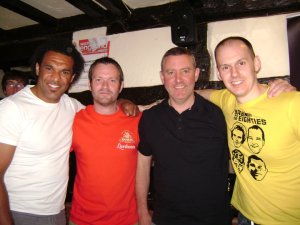
I sat and watched the game in the company of my fellow blogger, Dave Bytheway and Wolves legends Don Goodman and Robbie Robbie Robbie Robbie Dennison.
Because the yanks popped up with that late winner against Algeria, our route to the final couldn’t now really be any tougher. Get past Germany and we will probably have to face our old foes, Argentina in the quarters, Spain in the semis and then probably Brazil in the final.
How bloody exciting! What a way to win a World Cup – by beating the teams ranked 6th, 7th and then 2nd and 1st by FIFA.
The old cliché is that to win any World Cup you must at some point play and beat the best teams in the world – it’s just a shame that England will probably have to play all of them in one tournament if they are to be victorious on July 11th.
When the jaded old Italians won the cup four years ago they only had to get past Ghana, USA and the Czech Republic in the group stage, followed by Australia in the 2nd round and the Ukraine in the quarters.
They didn’t really face any quality until they beat Germany in the Semi’s and then they stumbled to a penalty win against France in the Final.
So, if we are to win the whole damn thing, then no other team in the history of the competition will have tackled so many top ranked teams on the way to victory.
With their usually perfidious manner, most of the media in this country rate our chances of success as likely as Theirry Henry appearing in the next production of Riverdance in Dublin.
Well, stuff em’. We started slow in ’66 and ’90 and there were times against Slovenia when you could see the passing was more fluid and the attacking more incisive than the previous two games. Wazza started to look back to his old self before he was taken off and the diamond formation in midfield certainly brought the best out of Stevie G, Lamps and erm, Milner.
Of course, the route to the last eight starts on Sunday against ze Germans, who have looked brilliant on occasions against the Aussies and Ghana but certainly fallible when they lost to the Serbs.
So, how do we beat them? They are a young team and experience often tells on the big stage and at major tournaments. Consider that the finalists four years ago – France and Italy – had the oldest average age of any of the teams and this time round England have plenty of experience in their ranks.
We don’t have a Russian linesman who lost half his family to the Nazis in the war to rely on as in ’66, but we are playing in red and on the BBC – two good omens – although we were wearing white when we destroyed the Germans 5-1 in their backyard.
What other straws can we clutch at? Did you know that in speed tests at Arsenal, Matthew Upson was only just behind Thierry Henry when it came to sprinting? See, what are we worried about? Well probably that Upson will be replaced by Ledley King, or more than likely three lion loving Jamie Carragher, who should be ashamed to have put the England shirt back on.
How about the fact that this World Cup has thrown up plenty of surprises? We say surprises, but anybody with an ounce of footballing knowledge probably predicted that France and Italy would be poor. New Zealand drawing their three games and Spain’s loss to the Swiss, there were two genuine surprises.
Hopefully Spain will get through today, although now we could be facing them down the line in the semis, I’m not so sure I want them to!
Unlike ze Germans, perhaps England have paced themselves to not peak too early and improve game by game. Perhaps Fabio just needed these early games to iron out the mistakes; mistakes like playing Robert Green or Gerrard on the left or thinking that Shaun Wright Phillips belonged in an England shirt.
Wouldn’t it be fabulous for a repeat of Munich in 2001? We achieved that 5-1 with Nicky Barmby in the side, which just proves that everything is possible!
Sunday’s game in Bloemfontein could be an absolute humdinger. If Gareth Barry can mark their danger man Mesut Ozil out of the side, we probably have a chance to win it in 90 minutes.
What is more likely is that the game will go to penalties. And to paraphrase Kevin Keegan, I’d love it if we beat them – via penalties. Wouldn’t that put a few ghosts to bed eh?
And if the unthinkable happens and we lose, then the retailers who promised full refunds on big TVs bought before the tournament if England won the World Cup – will probably be the only happy people at work on Monday.
Finally, this country lost one of its comedic powerhouses on Monday 21st June in Chris Sievey, the genius behind the character of Frank Sidebottom.
A group has been set up to try to propel Sidebottom’s recently-recorded World Cup song ‘Three Shirts On My Line’ to Number One. Campaigners are hoping to get one of the major download sites to host the track.
The video is below, and if you like it, please pop along and let’s see if we can get the great man to number one.
Enjoy the game. Come on Engurland!
World Cup Blog 7 – Boring World Cup
The World Cup final kicks off in a few hours time and I’m hoping it will be an entertaining game, because god knows this tournament needs some form of redemption.
Most people I’ve spoken to have found this year’s tournament a tad on the dull side to say the least. And it’s not just because of England’s pub team displays and early exit that have seen people give up on the tournament. It’s just all been a bit rubbish.
We can blame the altitude, the Vuvuzelas, the Jubalani, the long Premiership season, Pavlos Joseph, orange dresses, Paul the psychic octopus, goal-line technology, tactics, anything but the fact that the football on offer as been way below the standard it should be.
This could well go down as the worst tournament of all time. Forget FIFA and Sepp Blatter bleating on about what a fantastic atmosphere the whole thing has been played in – it’s been a stinker.
Apart from the English, so many other teams have underperformed.
The failure of the South American powerhouses Argentina and Brazil to get beyond the quarter finals perhaps has much to do with the idiotic romantic notion of fast-tracking their national footballing heroes into managerial posts they are ill-equipped to deal with.
After the Germans gave his team an absolute pasting, Maradona was bizarrely welcomed back to Buenos Aries like a national hero. It seems they will forgive him for just about anything. Dunga on the other hand was welcomed back with a carriage clock and a P45.
Dunga’s detractors will point to the fact that he decided to leave Pato, Neymar, Adriano and Ronaldinho at home whereas Maradona will probably be given a 25 year extended contract for having the foresight to choose Championship duo Coloccini and Gutierrez over the Inter pairing of Zanetti and Cambiasso.
At least we could all laugh at the French, who decided this tournament to go all Dutch, and squabble like a bunch of moronic Big Brother contestants.
If football was played on paper, you would look at Les Bleus team sheet and coo over their amazing depth of genius. Yet talented stars like Ribery, Evra, Gourcuff, Henry, Malouda and Le Sulk (Anelka) failed miserably in the tournament and were a laughing stock the world over.
I’d imagine that having Raymond Domenech at the helm of a national team would be akin to the FA appointing Lembit Opik as the next England manager. Lembit would immediately deploy the Cheeky Girls on the flanks and he’s enormous angled chin would solve our goalkeeping problems in an instant.
So much was expected from players such as Messi, Ronaldo, Drogba and Torres but none of them really delivered. But the biggest disappointment for England fans must be Wayne Rooney, who for me was simply our worst player in South Africa.
Perhaps too much was expected of the tournaments ugliest player and he had the heavy weight of a nation’s dreams on his shoulders after banging in 34 goals for the Red Devils and came into the World Cup in scintillating form.
But whereas Spain were able to carry Torres, who has probably been just as abject as Wazza, why couldn’t England do the same?
Anybody who saw the wonderfully nostalgic piece of TV a few nights ago ‘Gazza’s Tears – the night that changed football’ will have seen the canyon of difference between the national team today and that of two decades ago.
I don’t see the team that played so poorly in South Africa showing the same emotion and passion that drove the England team to the Semi Finals in Turin.
Back in Italy ’90, England was a team of leaders in Waddle, Platt, Butcher, Lineker, Walker and Bryan Robson. All led by an inspirational true English hero in Sir Bobby Robson, a father figure and a motivator with a brilliant footballing brain.
Bobby was nearly ousted by the media before the tournament begun in Italy; now contrast that with the pedestal Capello was thrust upon this summer. A lot had been said about the Italian’s dictatorship rules and the rumoured cliques that surfaced within the camp.
Bobby Robson told his players before the semi-final, “I just want you to know that whatever happens tonight, I’m proud of every single one of you.” You could never imagine Fabio Capello muttering those words in broken English. And if he did, he would be a liar.
Prior to South Africa the players said they were motivated by videos from the troops in Afghanistan, but this was clearly not the case. Perhaps the 2012 crop of footballers who carry the over-optimistic hopes of every England fan should be sat down and shown Gazza’s Tears. I imagine, and hope, that if Capello’s men saw what glory meant to the Italia 90 team, each and every one of them would be humiliatingly ashamed of themselves.
Anyway, with an hour before the World Cup final, I can only hope that perhaps all the insipid football of the last four weeks will be banished from the memory with the greatest footballing feast the world has never seen. Or the Spanish could have 99% of the ball without really ever threatening the Dutch goal and win 1-0 with a deflected goal off Howard Webb’s arse?
Let’s be honest, the only thing we will remember about this World Cup in 20 years time will be the bleedin’ Vuvuzela!
World Cup Blog 8 – World Cup XI
It seems odd talking about the World Cup; like it happen ages ago, rather than just the couple of days.
The final between the UFC inspired Dutch and the Tika Taka Spanish, epitomised the whole tournament for me – completely uninspiring.
And during the game I was embroiled in a rather ridiculous Twitter online argument with a Canadian called Johhnie Oil. Mr. Oil was adamant that it was the Spanish and not the Dutch doing the cheating in the game and he used a variety of expletives to describe the refereeing performance from our own Howard Webb.
I pointed out to Johhnie that the Dutch tactic was obviously to stop España from playing their natural game by kicking them up in the air at every opportunity. He was having none of it and said that the English **** of a ref was falling for all of the Spanish dives and ruining the game.
Anyway, it at least added an interesting element to a dull game which was bereft of genuine incident apart from some rough tackling and poor shooting.
After the game had finally finished, I was astonished to find that Diego Forlan had won the Golden Ball for player of the tournament. He has had a decent World Cup, no one can take that away from him, but surely there were more worthy recipients?
Probably most people’s choice for the Golden Ball would have been Iniesta, but I would have picked Schweinsteiger who has bossed every game the Germans played in and is certainly a much improved player at international debate.
No point debating that anyway. How about my pick for an XI of the tournament?
Goalkeeper – Mark Paston (New Zealand)
No, I haven’t gone completely chicken oriental. Ex-Walsall keeper Paston, played in the only unbeaten team of the tournament and was rock solid in all three of their group games.
He conceded just two goals and his acrobatic display kept out Gildardino, Cannavaro and Gilardino as the All Whites pulled off one of the shock results of the tournament as they held the Italians.
He also made some fine saves against Paraguay and Slovakia and his inclusion in this list is a small victory for the common man. After all, Mark did take a year out of football to work for a recruitment agency in London!
Left Back – Phillip Lahm (Germany)
There is an argument for saying that Ashley Cole deserves a mention as he was easily our best player in South Africa. He didn’t have much competition though did he?
Whenever I watched the Germans play I was always impressed by Lahm and because Ramos had such an impressive tournament, the German captain takes the left back slot rather than his preferred right hand side.
Central Defence – Gerard Pique (Spain)
He once appeared a dozen times for Man Utd don’t you know? Yet the composed player who pinged 50 yard cross field passes in this tournament is completely unrecognizable from the one who spent 4 undistinguished years at Old Trafford.
The Catalan defender is now back at Barcelona and has matured into one of the best centre halves in the world.
Central Defence – Paulo da Silva (Paraguay)
Again, perhaps not an obvious choice, but Paraguay’s progress to the quarter finals was built on a fantastic team ethic that was summed up by this veteran Sunderland defender.
Right Back – Sergio Ramos (Spain)
Two obvious choices for this slot; Ramos or Maicon. A fluky goal isn’t enough to get you into my starting line-up though and Ramos has been consistently one of the best players in the whole tournament and is arguably the best right back in the world right now.
Left Wing – Wesley Sneijder (Holland)
What are the chances that Mourinho might try and take him back to the Estadio Santiago Bernabéu after such a magnificent World Cup? Twice voted man of the match for the Dutch and although he equaled Mueller’s goal tally of 5, he missed out on the golden boot because of assists, which frankly is a little daft.
Central Midfield – Bastian Schweinsteiger (Germany)
My best player of the tournament – he has fantastic composure on the ball and always gets his head up to pick out a colleague. I get the feeling the big spenders in the Premiership will be scrambling for his signature this summer.
Central Midfield – Andres Iniesta (Spain)
With Sneijder pushed out to the left, I’ve had to bring in Iniesta inside, even though he played on the left hand side of Spain’s midfield. However, as the Spanish played so narrow, you could argue that he did play quite central. Let’s not get bogged down in the detail. Andres had a fantastic tournament and to score the winning goal in a World Cup final is the stuff dreams are made of.
Right midfield – Mesut Ozil (Germany)
Just pipped to the post by our own Wazza for the tournament’s ugliest player, 21 year old Ozil announced himself on the big stage with a string of excellent performances as part of Joachim Low’s brilliant youthful German side.
The way he left Barry for dead and centred to Müller for Germany’s 4th should see the Russian and Sheik Premiership team owners doing battle for his signature before August.
Striker – David Villa (Spain)
Whereas Torres was supposed to lead the Spanish to World Cup glory, it was instead the diminutive former Real Zaragoza player who bagged five goals in the seven games and was in imperious form in South Africa.
Striker – Diego Forlan (Uruguay)
Perhaps a little redemption for a player who was a bit of a laughing stock during his failed stint at Old Trafford? I’m still not convinced he deserved player of the tournament, maybe if that last minute free-kick had flown in against the Germans he would have been a shoe-in.
Nevertheless, he has had a great World Cup and lead the line wonderfully for Uruguay who surprised everyone by being the best placed South American side.
So there you have it, not an Englishman in sight. However, I’ve compiled a quick World Cup Worst XI and lo and behold a couple have sneaked in, coached of course by France’s answer to the wally with the brolly, Aquarian (star sign not fish tank owner) Raymond Domenech :-
GK – Ri Myong-guk (North Korea)
LB – Patrice Evra (France)
DF – Jamie Carragher (England),
DF – Fabio Cannavaro (Italy),
RB – Martin Demichelis (Argentina)
LMF – Steven Pienaar (South Africa),
CM – Sani Keita (Nigeria)
CM – Felipe Melo (Brazil)
RMF – Shaun Wright-Phillips (England)
ST – Wayne Rooney (England)
ST – Fernando Torres (Spain)
World Cup Blog 9 – Worst Miss of All Time?
Its one of those obvious football clichés that every time a player misses an open goal – the commentator sees fit to describe it as possibly the worst miss of all time.
When Iwelumo missed that sitter for Scotland against Norway, I’m sure many England supporters looked on enjoying a large dose of schadenfreude. But the Yak’s howler was too excruciating to take pleasure from and anyway, was it really the worst miss of all time?
To complete my series of 10 Lionheart World Cup blogs, below are my top XI of worst misses of all time.
Let’s kick off with number 11.
11. Cristiano Ronaldo (Portugal) – Sheffield Utd vs. Man Utd
As much as I would love to put this prancing, slimy, winker’s miss much higher up the chart; there are howlers much more horrific than this gem.
The acne ridden, cheating, Greg Louganis inspired Portuguese grease monkey had a poor World Cup, like many of the so called big stars. But this was probably due to the fact he was often isolated up front.
Still it’s rewarding to see Portugal slip to number 8 in the FIFA ranking, overtaken by a team whose World Cup performances will go down in folklore, the mighty England!
10. Chris Iwelumo (Scotland) – Scotland vs. Norway
I have an obvious soft spot for Big Chris. He was a massive contributing factor as to why Wolves finally restored their Premiership season and my missus enjoyed seeing him in his pants on the catwalk in a charity fashion show at Molineux.
You don’t get many chances at International level and this miss was probably the death nail in the man with the unpronounceable surname’s career in a Scotland shirt. It’s only because I love the man that this miss isn’t higher up this chart.
9. Yakubu Ayegbeni (Nigeria) – Nigeria vs. South Korea
I think his lowly position at number nine this just proves my point that It wasn’t the worst miss of all time, well I didn’t think so. I suppose the fact that this goal was the difference between Nigeria going home and advancing to the 2nd round of the recently concluding World Cup probably doesn’t help the Yak’s cause.
He did slot a penalty away a few minutes later – but I doubt that was enough to appease the Super Eagle fans enjoying the first ever World Cup in Africa, especially given Yakubu’s little grin as he misses this goal.
8. Nwankwo Kanu (Nigeria) – West Brom vs. Boro
A fellow Nigerian and perhaps just an excuse to shoehorn an Albion player into my top ten.
But Kanu believe that this miss (ahem) was from the same player who annihilated Chelsea with a stunning hat-trick at Stamford Bridge when he wore the red of Arsenal?
7. Steve Bruce (England) – Man Utd vs Reading
Obviously Brucey wasn’t known for his goal prowess, but even his granny (as Rhod Gilbert points out in the commentary) could have slotted this one home. I love this video clip of Fergie’s seven worst moments for Man Utd – Steve’s miss is at number 3 in this clip.
6. Jon Dahl Tomasson (Denmark) – Feyenoord vs. NAC Breda
He simply never cut at Newcastle and with scoring prowess like it this, it’s not tricky to work out why. It doesn’t matter how many times you watch this clip, you’ll never be able to understand how he got it over the bar.
If this happened whilst you were playing a bit of PES or FIFA on your consoles – you would be shouting at your TV saying that the programmers should start becoming much more accurate with the gameplay.
5. Rocky Baptiste (England) – Harrow Borough v Waltham Abbey
I think this one only fails to be higher up the chart because of the level of player. Giant Rocky is probably best remember for two things; his heroics in the colours of Havant & Waterlooville and unfortunately this monumental miss.
4. Ronnie Rosenthal (Israel) – Aston Villa v Liverpool
Rocket Ronnie is fondly remembered by Liverpool fans and remarkably actually features at number 76 in the poll 100 Players Who Shook The Kop.
He did score a sublime hat-trick against Charlton on his debut and when he switched to play for Spurs he repeated this feat as his team came from 2-0 down at halftime to beat Southampton 6-2 away at the Dell.
His legacy though is topped by this amazing miss away at Villa.
3. Ilija Sivonjic (Croatia) – Dinamo Zagreb v Cibalia Vinkovci
It must be a quite horrible feeling in football when you are only ever remembered by the viewing public because of something calamitous on the pitch.
Step up then this little known 23 year old Croatian. If he was defending, this would have been a wonderful bit of skill – to trap the ball on the line. He wasn’t though and I’m sure he just wanted the ground to open up and put him out of his misery.
2. Diego Forlan (Uruguay) – Man Utd v Juventus
Diego will be returning to his homeland in South America as something of a hero after his brilliant exploits over in South Africa. As I mentioned in my last blog, its go someway to redeeming a player that many of us saw as something of a joke when he played in the colours of Man Utd back in 2002 – 2004.
This miss epitomises his nightmare spell at Old Trafford and wouldn’t have helped boost his ailing confidence in front of goal.
1. Kei Kamara (Sierra Leone) – LA Galaxy v Kansas City Wizards
The pinnacle of misses, the Pièce de résistance of uselessness, the miss to end all misses – you get the idea. Kei Kamara is a player who will only ever leave this legacy behind. I love his face of innocence as he gets up after palming the ball into the goal.
It might not be the worst miss of all time, but surely the funniest.
I’ve stuck a compilation of other misses below. Thanks for reading mine and my fellow bloggers World Cup blogs during the last couple of months.
I’ll be back blogging about the ups and downs of Wolves in the forthcoming Premiership season. Enjoy the rest of the summer, traaa a bi.
 @Wolvesblogger